.png)

Tiger Bones Glue: A New Threat to Tigers in India
- FD Correspondent
- Mar 1, 2025
- 5 min read
Humans’ urge and search for magic medicines to stay in their pink of health past their prime has been a long one. Tiger bones glue is one such cure which has joined the long list of supposed elixirs of life.
Whether it is strengthening the muscle and bone and increasing the libido of their customers or not as the myth created around it has convinced people to believe, but it has spawned a market of thousands of cores in India and East Asia, particularly in China and Thailand over the past few years.



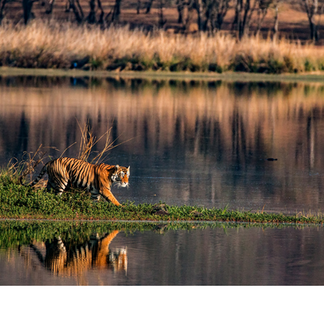


Tigers and other feline species are getting poached in large numbers to keep the supply of “wonder’ medicine going, particularly in forest areas of Madhya Pradesh and Maharashtra.
The trade is thriving into such a large business and fast that even illegal tiger farms in China and Vietnam and other countries are unable to meet the demands. The glue of wild tigers sells at a high premium in the market because people believe that it has more medicinal values for strengthening muscle bones and works as an aphrodisiac to increase sex drive. Its preparation takes three days of cooking in a pressure cooker. It finally takes a shape like a sac with liquid in it and is sold in a cake form.
A heightened patrolling in the core zones and fringe areas of Central Chanda Forest Division in Chandrapur district in Maharashtra recently led to the arrest of Ajeet Siyalal Pardhi alias Ajit Rajgond alias Ajit Pardhi, leader of infamous Bahalia poaching gang, and six others. The gang has a history of hunting 19 tigers in Maharashtra in the past, as revealed in the Melghat case, which had led to the arrest of 150 poachers. Previously, Ajeet, a resident of MP’s Katni district, was arrested by the State Task Force in July 2024 from Seoni district of the State.
Though, the notorious poacher was sentenced but was later released on bail in September 2024, said a senior forest official adding that bail to him was a blow to the entire forest department, especially for the State Tiger Task Force.
The busting of the gang of these poachers has turned the spotlight on this illegal international trade of multi-million rupees involving poachers from India, China and Vietnam, roaming and killing tigers in thick tiger population areas in India. They poached tigers and leopards across India on instructions by their handlers, which are yet to be identified.
According to an estimate, poaching is among the reasons for deaths of a total of 628 tigers in the past five years. The Chandrapur district incident set the alarm ringing for Maharashtra that had lost three tigers due to poaching within 23 days between December 30, 2024 and January 22, 2025. Currently, Madhya Pradesh has the fifth-largest tiger population, and their numbers in Maharashtra have increased to 350 in the last sixteen years.
The Wildlife Crime Control Bureau (WCCB) of the Union Government recently issued a red alert about the presence of wildlife poachers, for intensifying surveillance and enforcement of measures to dismantle the poaching network. Subsequently, in Madhya Pradesh, known as the Tiger State of India, because it has the highest tiger population in the country, the office of the Chief Conservator of Forest (Wildlife), State Tiger Task Force issued an alert on January 29.
“In August 2023, State Tiger Task Force of Madhya Pradesh arrested notorious tiger poacher Kalla Bawariya, a resident of Hoshiyarpur district in Punjab. During interrogation he revealed the presence of tiger poachers and wildlife traders in the States of Maharashtra, Assam, Tamil Nadu and Meghalaya”, the alert revealed. Thereafter, Madhya Pradesh Forest and State Tiger Task Force conducted raids, seized skin and bones of dead wild animals, devices and tools used in poaching.
“We conducted a raid in Devari village, and found a leopard carcass, paws of hind legs and recovered tools used for poaching,” says the Divisional Forest Officer, Jabalpur.
Barely five-days later, MP Forest Department's State Tiger Strike Force raided Padariya village in Shahpura area of Dindori district. Though the operation resulted in the seizure of a large quantity of explosives, a long net (used to capture wild animals), the Tiger Strike Force was unable to capture fugitive Surya, a wanted kingpin of the wildlife smuggling racket.
The seizure also included about seven quintals of Ganja that indicates involvement of illegal wildlife traders in narcotics trade as well. The quantity of Ganja was so huge that the authorities had to arrange a JCB machine to unearth the large stash of ganja buried at a hideout and hire weighing machines to weigh it.
Notably, the State has reported 46 tiger deaths in 2024, marking the highest number of tiger deaths in India since the launch of Project Tiger in 1973. Expressing his concern over the recent developments and arrest of the Bahalia gang leader by Maharashtra Government, Ajay Dubey, wildlife activist questioned investigations of Madhya Pradesh Forest Department that had arrested the gang leader in July 2024.
“The poachers have killed hundreds of tigers in Bandhavgarh, Panna and Satpura Tiger Reserve in the last few years. But no mastermind ever got arrested…in fact, notorious Ajeet who was arrested earlier by Madhya Pradesh Forest Department managed to get bail because of the weak investigations”, Dubey alleged.
Meanwhile, reports of the Wildlife Crime Control Bureau (WCCB) and other State Forest Departments officials led to busting of a network of poachers and illegal traders involved in smuggling endangered animal parts from another Maharashtra’s neighbouring State – Telangana.
The forest officials from Komaram Bheem Asifabad forest division in Telangana, intercepted a gang of Baheliya poachers, fleeing by train from Maharashtra, at Sirpur Kagaznagar railway station. They rounded up as many as 16 adult poachers, men and women, who were travelling with their children.
Wildlife enthusiasts feel that tigers in Madhya Pradesh, Maharashtra, and Chhattisgarh are at high risk, with poachers increasingly targeting tiger reserves in these states. According to WWF, poaching is the most immediate threat to wild tigers. Every part of the tiger—from whisker to tail—has been found in illegal wildlife markets. Their bones and other body parts are used for health tonics and folk remedies, and their skins are sought after as status symbols among some Asian cultures.
What’s revealing is the World Wildlife Crime Report Trafficking 2024 published by the United Nations Office on Drugs and Crimes (UNDOC) which says that wildlife animals are in demand for its use as food, medicine, in fashion, for ornamental purposes, investment pieces and as pets. Each of these demands has its own trends and dynamics.
It is a fact that tigers are largely consumed for medicinal purposes in both China and Vietnam. China is known to have a preference for tiger bone glue. This product is also consumed in Vietnam. One species enjoyment is another one's violation of the right to life. Coexistence is rule of the ecological balance. But humans are disturbing it to their advantage and to huge disadvantage of other equal claimants of Planet Earth.


Comments